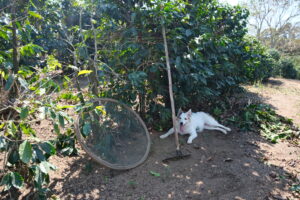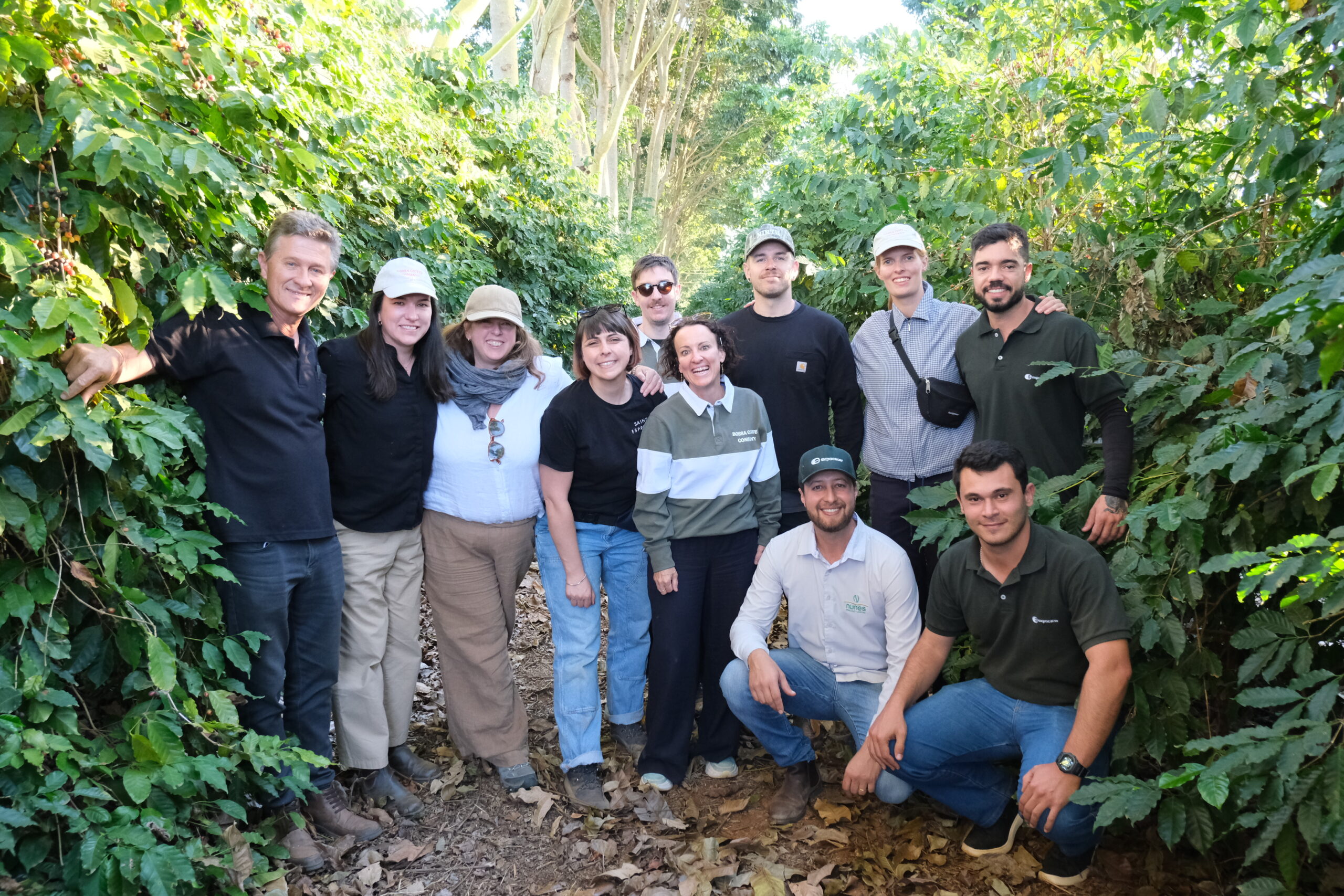
In July, we had the privilege of spending quality time in Brazil, visiting some of the farms and exporters we’ve sourced from for many years. This crop was tipped to be Brazil’s biggest harvest on record, so optimism was high that the coffee shortage of the past few years would finally ease, with larger inventories replenishing stocks and helping close the global deficit.
Like anyone sitting in the south of England currently we are in drought, we can’t assume the weather is going to behave in any historical fashion these days. That uncertainty was compounded by news that a super El Niño was looming ahead of the harvest.
Here’s what we saw on our visits, what producers told us, and a few insights from the trip.
Expocacer in Cerrado
We started our trip in Patrocínio, Minas Gerais, home to Expocacer’s office and two dry mills. Expocacer is the second-largest coffee cooperative in Cerrado, with over 800 producer members, and we (Bossa Coffee) are their UK representative giving us access to a wide range of coffees from across the region. Our sourcing focuses mainly on the environmental and social project farms, which now we have almost 80 members practising regenerative agriculture. Back in 2022, there was only one regenerative agriculture producer. It’s been a real success story for the region, which has faced one environmental challenge after another, from historically poor soil quality to extreme weather.
Fazenda Douradinhos – Elisabete Martins
Elisabete is a new member of the cooperative, and we’ve been importing her coffees into the UK since 2024. We were the first overseas guests to visit her farm which was a huge honor. Once we arrived, we saw first-hand the damage the harvest-season rains had caused. As harvest falls during Brazil’s dry winter season, the unseasonal rain triggered premature flowering before harvesting was even finished. Cherries left on the plants while producers waited for the rain to pass began to dry out, while others along with branches were torn off by wind and rain. Beans that fall to the ground are collected later in the harvest and are used for commercial-grade coffee. This means less higher quality coffee will be available from this crop. Elisabete’s son, who manages the farm, showed us around and hosted us for a lovely, homely afternoon tea.
Fazenda Atriz – Beatriz Guimarães
The first question on everyone’s mind is always the farm’s name – it’s a blend of the couple’s names, not a nod to a famous actress. Last season we sourced a fantastic anaerobic lot from Beatriz Guimarães, and hers was the largest farm we visited by production volume. The Guimarães family grow a wide range of varietals and processing methods and have picked up plenty of awards over the years for their coffee and their cattle farming alike. They produce around 30,000 bags of coffee annually which is astonishing. For context of scale the producers we work with in Mogiana are much smaller and do 1000-2000 bags per harvest. We joined the family for a cupping session at their office in town, where quality and consistency were the focus, the preview of new crop lots on offer were tasting excellent.
Fazenda Horozontia – Elesandra and Fernando Beloni
We visited the Belonis’ second farm to check in on this crop’s production. The Belonis were the first coffee producers in the world to achieve Regenagri certification (not just the first in Brazil, as we’d previously understood). Their pioneering work has inspired many other producers in the region to adapt similar practices to their own conditions, and it’s a big part of why Expocacer’s regenerative producer list has grown to almost 80 – thanks to the Belonis’ research and the cooperative’s Educampo programme, which helps up skill producers and build resilience against a changing climate through generations. This farm is largely dedicated to coffee production, so it was a great chance to see the extra care Elesandra puts into the micro-lots each year. We were also treated to a stunning lunch, and Bruna got to plant a tree on her birthday during the visit a moment we’ll cherish and revisit for years to come.
Nunes Coffee Farm- Gabriel Nunes
This was our second visit to Nunes Coffee, where Father and son team Osmar and Gabriel kindly showed us around and updated us on their regenerative practices and composting. We revisited the Gesha plot, grown under towering shade trees that have shot up even taller since our last visit. The seeds for the Gesha were sourced from Dwight Aguilar, the Peruvian Cup of Excellence winner. Gabriel is also growing more unique varietals such as Aramosa. Cupping on-site is always a brilliant experience, and this preview of the new crop didn’t disappoint.
Fazenda Semente – Maria Vitoria, Eugenia and Jose Lucas
On our last day in the Cerrado, we stopped by Semente farm, returning the favour after Jose Lucas – one of the three siblings running the farm – kindly visited us in London during harvest season. They explained how important regenerative agriculture has been for the family farm since the 2021 frost nearly wiped out their entire crop. Since replanting, they’ve rethought a lot of what was previously standard practice, future-proofing production for generations to come. That includes planting only at higher altitudes, growing varietals with greater climate resilience, using more cover crops, and drip irrigating during dry spells. We cupped a range of coffees, including some seriously impressive micro-lots. The local coffee community here is tight-knit Gabriel’s wife, Maria Vitoria, is Jose’s sister, and the two families share processing and varietal knowledge, producing high-scoring lots and developing valuable research along the way. The highlight for us is that the main founder of what Fazenda Semente is today was thanks to Virginia, their mother, and the first woman to be a coop Member at Expocacer. What a lovely family!
Costa Café in Mogiana
We arrived in the evening and settled in with some local wine on the hotel rooftop, overlooking the town of Espírito Santo do Pinhal known locally as Pinhal, named after a typical pine tree in the region called Araucaria. Mogiana is Bruna’s home region, sitting within São Paulo state on the border with Minas Gerais. Since our last visit, all the local producers we work with have completed EUDR compliance on their farm polygons and passed their deforestation checks all the farms are improving quality by doing practices that are utilised in Regenerative but they don’t use this terminology, the practised are just working in a way that is the best for the land.
Fazenda Santo Antônio and São Benedito- Patrícia Coelho
Patricia is our longest-standing supplier relationship as an importer; we’ve been sourcing from her since 2018, when she moved from selling to high-end commercial buyers (mostly Nespresso) to supplying us for the UK specialty market. It’s always great to see how the farm has evolved. On this visit, we went to both of her farms to check on the harvest’s progress. The first, at higher altitude still had cherries developing on the plant, and recent high winds and rain had brought down some beans from the tree. We had to hop out of the truck more than once to help Patricia clear the path from fallen trees. Despite the unusual weather, the crop looked healthy overall, and we saw many of her varietals at different stages of development. Parts of this farm are too steep for mechanical harvesters, so much of the picking is done by hand. We also checked in on Guaspari Winery’s grapes and had a taste of how they were coming along – fun fact the most prestigious winery of the region is her neighbour and you can taste coffee and wine with the same terroir. The second farm, at slightly lower altitude, was in the middle of harvest, and we caught a mechanical harvester at work on the flatter land. All the processing here happens on the patios, overseen by Patricia’s son Pedro, an agronomist who lives on-site all year round.
Andrea Costa – Chácara Santo Antônio
Andrea is Bruna’s mum, and we’ve been importing her coffee since 2020, once quality reached specialty grade. She’s continued to improve things year on year since then. Andrea drove us round the farm in an old 1950’s restored jeep giving Jurassic Park vibes. The farm still grows Red Catuaí, Mundo Novo, and Arara varietals. The harvest here was also slightly delayed by rain, so we got to see mechanical harvesters at work and coffee being turned by rakes on the drying patios the work in the patios there is all done by hand.
Fazenda Barrinha – Andrea and Armando Costa
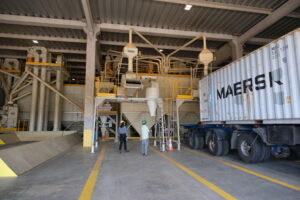
We spent our final evening at Bruna’s parents’ farm, enjoying a sunset dinner after touring their fruit and vegetable patch: bananas, papaya, limes, and cassava all growing there. They’ve also planted plenty of lavender to attract bees, with several hives dotted around the farm to support coffee pollination. This farm is going to be adding Arara too, as recent research shows it’s even more productive and resilient than the well-established Mundo Novo. Being at a lower altitude (around 950 mts) and more flat the specialty harvest here had already wrapped up, and we were lucky enough to see the first container being loaded at the dry mill.
Our takeaways
Having visited nine farms and spoken with exporters and producers throughout the trip, our overall impression is this: yes, volumes this harvest are better, but the June rains did real damage to the quality, and the availability of higher-quality lots has taken quite a hit. The extra flowering triggered by those rains, combined with the looming threat of a super El Niño, is a genuine concern for next year’s volumes. Ideally, coffee flowers uniformly, so the cherries ripen evenly and are ready to harvest together.
Producers are always looking ahead. As importers, we get to see both sides of the industry, which is something we find genuinely fascinating. The reality is that extreme weather events are only going to become more frequent, and it’s inspiring to see producers working hard to diversify the range of varietals and planting across different altitudes to future-proof coffee production for generations to come.
If you have not joined us on a trip to see these things for yourselves yet let us know you have interest and we will reach out when we start planning our next.